How-to
Crypto on-ramp and off-ramp explained 2026
On-ramp and off-ramp are the two bridges between traditional finance and crypto. On-ramp: EUR/USD → crypto. Off-ramp: crypto → EUR/USD. Deep dive: how it works technically, MiCA-licensed providers across the Baltic and Nordic region, fees, security risks and beginner guide.

On-ramp and off-ramp are the two bridges between traditional finance and the crypto world. On-ramp converts EUR/USD to crypto (via SEPA, card, Apple Pay or Open Banking); off-ramp converts crypto back to fiat via exchange or crypto card. In this deep dive we analyse the technical flow, KYC/AML requirements, the MiCA framework, the main EEA providers (Bitvavo, Coinmotion, Simplex, Krak, Bleap), the fee structure and a beginner guide.
On-ramp and off-ramp are two terms that describe the bridges between the traditional financial system (euros, dollars, cards, bank transfers) and the crypto world (bitcoin, USDC, ETH and other digital assets). Without these bridges the crypto ecosystem would be isolated - you couldn't buy your first BTC with a SEPA transfer and you couldn't cash out earned USDC back to EUR on your bank account. In this article we explain how it works in practice, which providers offer it across the Baltic and Nordic region, how the MiCA framework will reshape it in 2026-2027, and what to remember when picking an on-ramp.
What is an on-ramp
On-ramp is the process where a user converts traditional currency (EUR, USD, GBP) into crypto. Simply put: money from your bank account becomes digital assets.
Typical on-ramp scenarios:
| Scenario | Source payment | Output |
|---|---|---|
| SEPA to exchange | EUR from bank account | BTC or USDC in exchange wallet |
| Card purchase | Visa/Mastercard payment | BTC or other crypto |
| Apple Pay / Google Pay | iPhone/Android NFC | Crypto on exchange account |
| iDEAL/Bancontact | NL/BE local payment | Crypto |
| Open Banking | Direct bank-account linking | EUR → crypto |
Technically the on-ramp provider:
- Receives fiat (EUR) from the user's bank
- Runs KYC/AML checks (usually once)
- Converts fiat to the requested crypto at market price
- Delivers the crypto to the user's wallet or exchange account
What is an off-ramp
Off-ramp is the reverse - a user converts crypto back to traditional currency. It's the critical moment: something that existed as a digital asset on a blockchain becomes money on a bank account.
Typical off-ramp scenarios:
| Scenario | Source crypto | Output |
|---|---|---|
| SEPA withdrawal from exchange | BTC/ETH/USDC | EUR to bank account |
| Crypto card (Mastercard/Visa) | Stablecoin (USDC) | In-store payment |
| Crypto ATM | BTC | Cash |
| P2P platforms | Any crypto | EUR/USD with local user |
| Off-ramp API | Stablecoin | Direct bank payout |
Technically the off-ramp provider:
- Receives the crypto from the user's wallet
- Sells it on the market for fiat
- Runs the relevant AML checks (Travel Rule, sanctions filter)
- Executes a SEPA/SWIFT transfer to the user's bank account
How it works technically
Simplified on-ramp architecture:
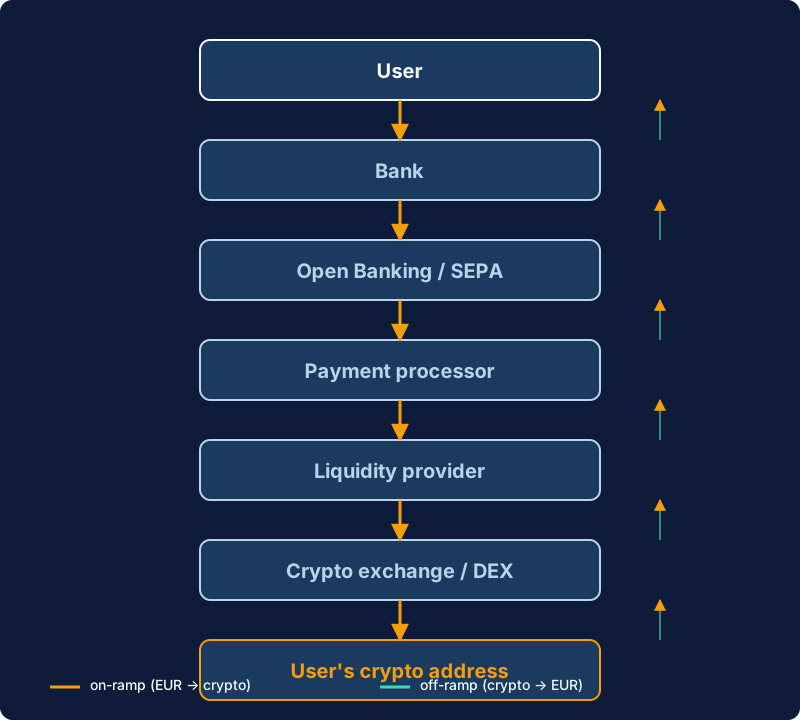
Off-ramp runs the same flow in reverse. Main technical challenges:
- KYC/AML compliance - every transaction checked against sanctions and illicit sources
- Liquidity provisioning - enough order flow to fill the purchase/sale instantly
- Price risk - in the 30 seconds between order start and completion, prices can move
- Travel Rule - FATF requirement to identify sender and beneficiary for transfers above $1000
- Anti-fraud - card payments carry a particularly high chargeback risk
Main on/off-ramp providers in the EEA
Specialised B2B on-ramp providers
- Simplex (a Nuvei subsidiary) - see our Simplex deep dive. The largest card-based on-ramp in EEA with many integration partners (Binance, Trust Wallet, etc.)
- MoonPay - similar B2B segment, more US/UK oriented
- Mercuryo - European alternative
- Transak - India-based global on-ramp
Exchanges as their own on/off-ramp
Most MiCA-licensed exchanges in Europe offer both on-ramp and off-ramp on their own platforms:
- Bitvavo - cheapest fees, free SEPA, iDEAL, cards
- Coinmotion - Finnish focus with EUR transfers
- Kraken - global with SEPA and card support
- Paybis Europe - dual MiCA + PSD2 licence, all-in-one
- Backpack EU - Solana focus with full MiCA + payment institution licence
Hybrid solutions - crypto cards with built-in off-ramp
Crypto cards are effectively an off-ramp at the moment of every transaction - the user pays with USDC, the system converts to EUR in real time and sends it to the merchant:
- Krak Card - Kraken Mastercard
- Nexo Card - dual Credit/Debit Mastercard
- Bleap - non-custodial Mastercard with 0% FX
- Crypto.com Visa, eToro Money - alternatives
MiCA regulation and on/off-ramp
Under MiCA, on-ramp and off-ramp services fall under:
- CASP (Crypto-Asset Service Provider) licence - mandatory for any provider offering crypto-fiat and fiat-crypto exchange to EEA customers
- Travel Rule - mandatory sender/beneficiary identification for transfers above €1000
- EBA and ESMA supervision - cross-border services require passporting notifications
- Transition period - until end-2026 each member state can set its own deadline (Finland 2025-06-30, Latvia 2026-06-30, etc.)
In practice this means:
- Customers - choose a regulated provider with verifiable CASP status
- Providers - obtain a CASP licence or partner with one
- Card issuers - additionally need a PSD2/EMI licence
See our MiCA Baltic explainer for the detailed analysis.
Fees and what to know about them
On-ramp and off-ramp fees are the biggest trap for beginners - they are often hidden in spread rather than stated explicitly. Typical fees in the EEA market:
| Service | Fee | Why |
|---|---|---|
| SEPA to exchange | 0% (Bitvavo, Coinmotion) | Bank doesn't charge |
| Card purchase | 1.5-4.95% | Card schemes + chargeback risk |
| Exchange spread | 0.1-2% | Depends on exchange tier |
| iDEAL/Bancontact | 0-1% | Depends on payment processor |
| SEPA withdrawal | 0-1 EUR | Depends on exchange |
| Card off-ramp (crypto card) | 0-3% FX | Depends on card provider |
The real total cost to a user usually lands at 0.15-3% depending on method. Bitvavo with free SEPA + 0.25% spread is the lowest in the region; card purchases (Simplex, MoonPay) usually sit higher at 2-4%.
Security risks and what to watch
Chargeback risk
Card payments carry high chargeback risk - a user can request a refund even after receiving the crypto. That's why card on-ramps are more expensive and sometimes slower.
KYC quality
Not all on-ramps are equally safe. Check:
- Does the provider hold a CASP licence in an EEA state?
- Does the company have a verifiable VASP/CASP licence in Latvia, Lithuania or elsewhere?
- How rigorous is the KYC process?
Sanctions risk
In an off-ramp scenario the user faces sanctions risk - if the depositing crypto address is linked to illicit activity, even unintentionally, the bank can freeze the SEPA transfer.
Rug pull risk
Small unregulated on-ramps carry real "rug pull" risk - clients can lose all the money paid in. Always pick a licensed MiCA CASP.
Beginner guide - how to do your first on-ramp
- Pick a licensed exchange - in the region Bitvavo (NL), Coinmotion (FI), Kraken (global). See also How to safely buy your first Bitcoin in Latvia 2026.
- Register and complete KYC - usually an ID card and selfie. 5-15 minutes.
- Do a SEPA transfer - cheapest option, usually free. Arrives within 1-2 hours in EEA.
- Buy crypto - start with a large, liquid coin like BTC or ETH. Avoid spread by using a limit order.
- Move to your own wallet (optional) - a hardware wallet like Ledger or Trezor for long-term holding.
Beginner guide - how to do your first off-ramp
- Make sure your exchange account already has KYC done - off-ramp usually doesn't allow new bank destinations without extra checks
- Move crypto to your exchange wallet (if it sits on a hardware wallet)
- Sell crypto for EUR - usually instant
- Run a SEPA withdrawal - 0-1 EUR fee, money arrives in 1-3 business days
- Make sure the activity is recorded in a crypto tax tool - Koinly, Divly or Blockpit
Regional specifics for the Baltics and Nordics
- Latvia, Lithuania, Estonia: the main on-ramp is a SEPA transfer to Bitvavo, Coinmotion or Paybis Europe. Card purchases via Simplex (the B2B integration embedded across many sites)
- Finland: Coinmotion is the local leader, Bittimaatti runs 50+ crypto ATMs
- Sweden: Trijo (GreenMerc), Northcrypto, Bitvavo
- Norway, Denmark: Firi and Lunar Block as regional leaders
- All EEA: Bitvavo (NL), Kraken (global), Bitpanda (AT)
Bottom line
On-ramps and off-ramps are the crypto ecosystem's lifeline - without them, digital assets would stay isolated from the real economy. By mid-2026 the best combined on/off-ramp setup for a Baltic or Nordic user is free SEPA to Bitvavo or Coinmotion, combined with a crypto card (Krak Card, Nexo or Bleap) for everyday spending.
During the MiCA transition through end-2026 the regional picture will shift - new licensed providers will appear, unregulated markets will fade. Users should stick to verified CASPs and avoid unregulated alternatives.
Top alternatives by category
- Cheapest SEPA on-ramp: Bitvavo (0%, 0.25% spread)
- Finnish local on-ramp: Coinmotion
- B2B card integration: Simplex
- Off-ramp via card: Krak Card or Bleap
- Professional order book: Kvarn X
- Simple mobile app: Bitvavo or Bitpanda