CLI vs GUI: is the command line the new standard?
The advantages of CLI over the graphical interface, the 2026 terminal renaissance, AI agents and crypto-exchange command-line tools. Has anyone aggregated multiple exchanges into a single CLI? Examples from the exchanges registered on our platform - Kraken, OKX, Crypto.com, Coinbase and CCXT.
In 2026 the command line (CLI) is enjoying a renaissance: speed, automation, machine-readable output and AI agents are making it the dominant interface in the professional segment. In this Norriwire explainer we analyse the advantages of CLI over GUI, the market trends, whether the command line is becoming the new standard for receiving up-to-date information, and whether any player has aggregated multiple crypto exchanges into a single CLI (CCXT - 100+ exchanges). We use the exchanges registered on our platform as examples: Kraken, OKX, Crypto.com and Coinbase, plus those that rely only on APIs/SDKs - Bitvavo, Bitstamp, Bitpanda, Gemini.
CLI vs GUI: is the command line becoming the new standard for working with crypto exchanges?
A few years ago the command line (CLI - Command Line Interface) looked like a relic of the past - a black window with a blinking cursor, meant only for programmers. In 2026 the picture has changed. Modern CLI tools have become fast, visual and intelligent, and crypto exchanges are shipping their own command-line interfaces one after another. In this Norriwire explainer we analyse the advantages of CLI over the graphical interface (GUI), whether the command line is truly becoming the new standard for receiving up-to-date information, what the market trends are, and whether any market player has already aggregated multiple exchanges into a single CLI platform. We use the crypto exchanges registered on our platform as examples.
CLI and GUI - what is the difference
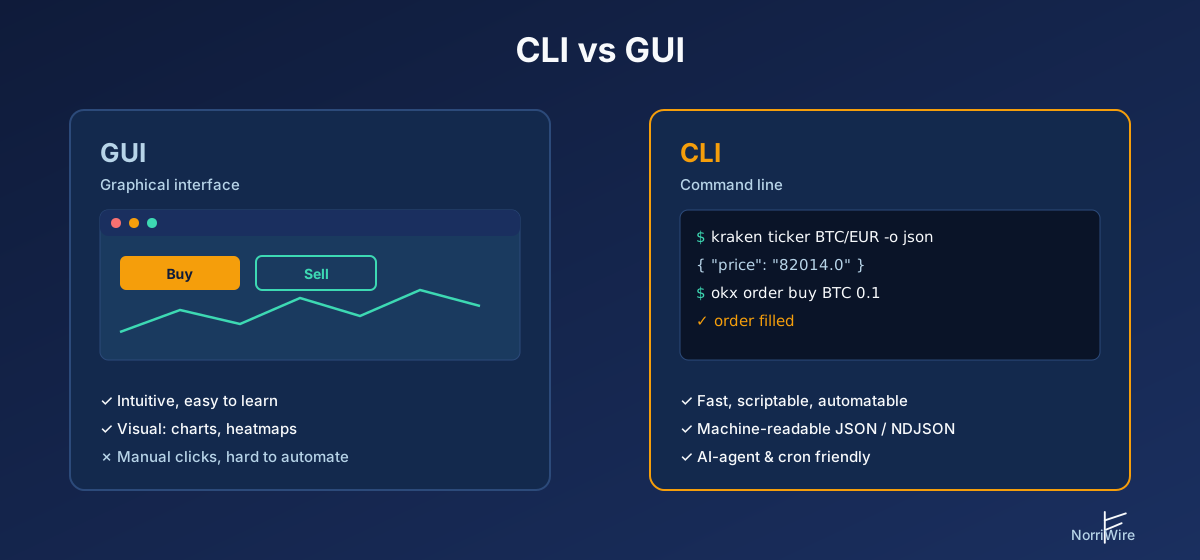
GUI, the graphical user interface, is what most people use every day: buttons, menus, charts, mouse clicks. It is intuitive and easy to learn because everything is visible on screen. The CLI, or command line, works differently - the user types text commands and the program answers with text. No buttons, no mouse; only commands and their results.
This difference defines the strengths of each approach. GUI wins on first contact and in situations where visual information matters - candlestick charts, portfolio breakdowns, colourful heatmaps. CLI wins where speed, repeatability and automation matter: the same command can be run a thousand times, dropped into a script, attached to a scheduled task, or piped into another tool.
The key advantages of CLI
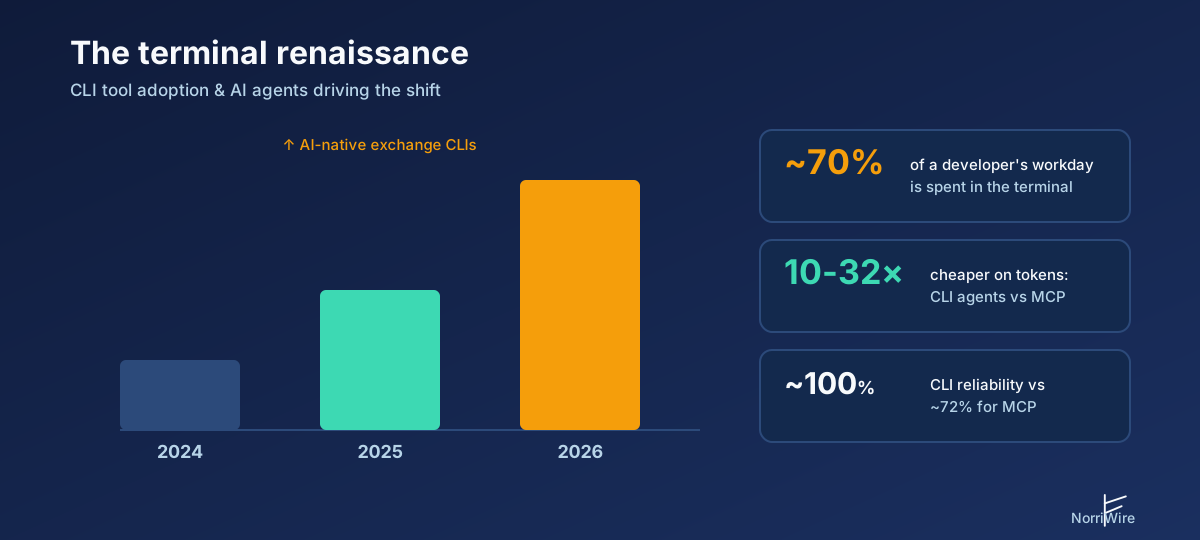
The first advantage is speed and less context switching. Studies show developers spend roughly 70% of their workday in the terminal. When everything can be done in one window - without switching between browser, app and spreadsheet - you save not just seconds but mental energy.
The second advantage is automation and scriptability. A CLI command can be placed in a cron job that fetches exchange price data every morning at 6:00 and sends it to your system. In a graphical interface the same task would require manual clicks every time.
The third advantage is machine-readable output. Modern CLI tools return data in structured JSON or NDJSON, easy to pipe into tools like jq or feed directly to an AI model. This very property makes the CLI a natural bridge between exchanges and AI agents.
The fourth advantage is transparency and precision. A command always does exactly what is written in it, and it can be versioned, reviewed and repeated. The graphical interface changes with every update; the command stays stable.
2026: the terminal renaissance
Over the past two years the CLI has experienced what industry media call a "terminal renaissance". Practically every serious developer-tooling company shipped or meaningfully updated a CLI in 2025-2026. Every major AI lab shipped a coding-agent CLI, and every major SaaS company shipped its own service CLI.
Artificial intelligence is amplifying the trend. The Model Context Protocol (MCP), introduced by Anthropic in late 2024, became the standard for connecting AI agents to external tools. But 2026 brought an interesting twist: one study ran 75 comparative tests between MCP-based and CLI-based agents performing identical tasks and found that CLI won every efficiency metric - it was 10 to 32 times cheaper on token consumption, with reliability around 100% versus MCP's roughly 72%. In practice the most effective 2026 architecture uses both: CLI for everyday operational tasks, MCP where enterprise-grade authentication is required.
Why crypto exchanges in particular are moving to the terminal
The crypto market is ideal soil for a CLI boom. Prices change in seconds, traders want automation, and an increasing share of actions is performed not by humans but by AI agents. That is exactly why the largest exchanges began offering "AI-native" CLI tools with a built-in MCP server in 2025-2026 - tools that serve a human at the terminal and an automated agent equally well.
Of the exchanges registered on our platform, four currently offer an official command-line interface:
Kraken launched kraken-cli - an open-source single-binary execution engine with 134 commands covering spot trading, futures, staking and subaccount transfers, plus WebSocket streaming. It has a built-in MCP server and a paper-trading mode for testing without real money.
OKX offers okx-trade-cli (agent-trade-kit) - a Node.js tool for spot, swap and futures trading as well as grid-bot management straight from the terminal, with an MCP server for AI integration.
Crypto.com released cdcx-cli - a tool with a full interactive terminal dashboard (TUI) with six tabs (market, portfolio, orders, history, watchlist, positions) including inline candlestick charts and heatmaps, plus a scriptable CLI and a native MCP server.
Coinbase offers cdp-cli through its Developer Platform - a unified interface to the full CDP API surface (payments, trading, wallets), generated dynamically from the OpenAPI spec, plus official sample CLI tools for individual products.
The other large exchanges registered on our platform - for example Bitvavo, Bitstamp, Bitpanda and Gemini - do not yet offer an official CLI. They do provide REST/WebSocket APIs and SDKs (most often Python) on top of which anyone can build their own command-line tool or use third-party solutions. This is an important nuance: an API underpins everything, but an official CLI means the exchange itself maintains and supports the tool.
Has anyone aggregated multiple exchanges into a single CLI?
Yes. The biggest example is CCXT - an open-source library that supports more than 100 crypto exchanges and also offers a command-line interface. With it you can connect to any supported exchange straight from the terminal, check balances, place orders or fetch trade data without writing custom code. CCXT is essentially a universal "translator" between the differing APIs of many exchanges and a single set of commands.
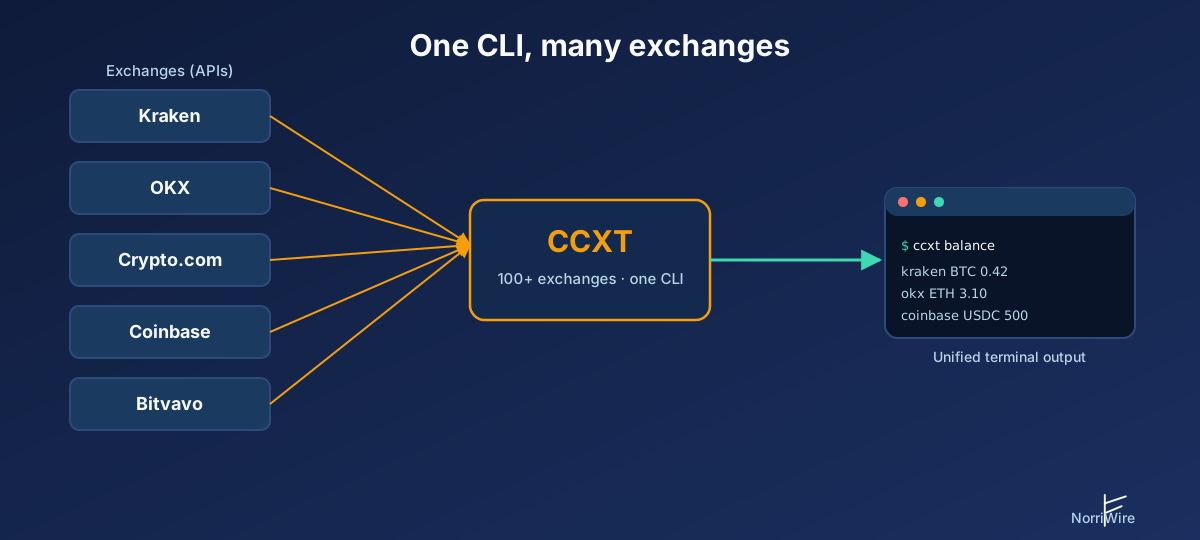
Alongside it there are tools such as Hummingbot (an open-source trading-bot system that connects to many exchanges from the terminal, including some in our register) and various terminal-style third-party clients. It is worth noting the contrast: the largest multi-exchange aggregators known to a wider audience - for example Bitsgap (17+ exchanges) or Altrady (19+ exchanges) - are still graphical-interface platforms, not CLIs. This means a true multi-exchange CLI aggregator currently lives mainly in the open-source space (CCXT, Hummingbot), while commercial aggregators still cling to the GUI.
What it looks like in practice
Here is a simplified example of how to fetch a price and place an order with an official exchange CLI - something that in a GUI would require several clicks and a browser window:
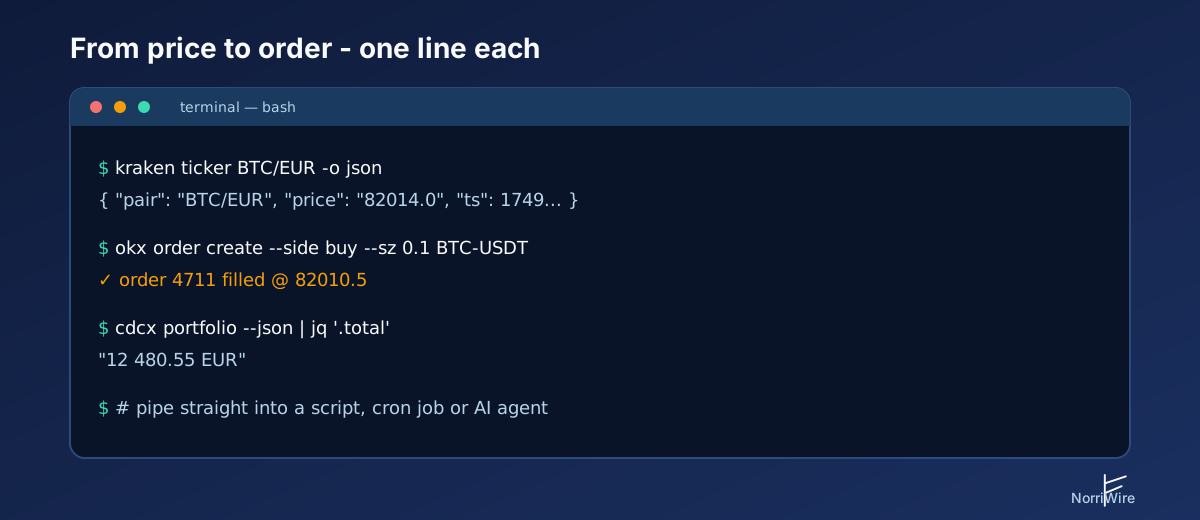
The difference is striking. In a graphical interface you must open the browser, log into the account, find the trading page, choose the pair and fill in the form. On the command line it is a single line that can be saved, repeated or automated. That is precisely why the CLI is so attractive to algorithmic traders and AI agents.
Is the CLI really the new standard?
The answer is nuanced. The CLI is not becoming the standard for everyone - for the average user who buys a little Bitcoin once a month, a graphical app remains the more convenient choice, and it is not going anywhere. But in the developer, algorithmic-trader and - this is the novelty - AI-agent segments, the CLI is becoming the dominant way of working with up-to-date information and executing actions in 2026.
It is more accurate to say a hybrid model is forming. Modern CLI tools adopt GUI intelligence and visual polish (built-in charts in the terminal, autocompletion, coloured output) while keeping terminal speed and scriptability. In the other direction, exchanges increasingly wrap their powerful backend APIs in GUI, CLI and MCP form at once, letting the user choose the interface. The very fact that exchanges like Kraken, OKX, Crypto.com and Coinbase invested in official CLI tools in 2025-2026 is the strongest signal that the command line is moving from a niche tool to a first-class interface.
Key takeaways
The advantages of CLI over GUI are speed, automation, machine-readable output and precision; the advantages of GUI are intuitiveness and visual information. In 2026 there is a pronounced terminal renaissance amplified by AI agents, and studies show the CLI approach to be cheaper and more reliable than a purely MCP-based one. Of the exchanges registered on our platform, Kraken, OKX, Crypto.com and Coinbase offer an official CLI; the rest rely on APIs/SDKs. For aggregating many exchanges into one CLI the leader is the open-source CCXT (100+ exchanges), while commercial aggregators still rely on the GUI. The CLI is not becoming the only standard, but in the professional and automated segment it is clearly becoming the default interface.
Disclaimer
This is an educational and analytical article, not investment or technical advice. Using CLI tools in trading carries risks - never share your API keys, store them only locally, and test tools in paper mode before real trading. The market picture changes fast; check current information directly at the sources before making decisions. Norriwire does not provide personalized financial advice.
Sources
- Kraken: kraken-cli (official repository)
- Kraken Blog: Announcing the Kraken CLI
- OKX: agent-trade-kit (okx-trade-cli)
- Crypto.com: cdcx-cli launch
- Coinbase: Introducing @coinbase/cdp-cli
- CCXT: cryptocurrency trading API (100+ exchanges)
- DEV Community: The Terminal Renaissance - Why CLI Tools Are Eating Dev Workflows in 2026
- DevConsole: CLI vs MCP - The Ultimate 2026 Developer's Guide